Becoming Myrrhbearers
This is an excerpt taken from an episode of the podcast Raising Saints, originally posted on May 9, 2015. I am amazed to find that I’ve been talking about myrrhbearing love for ten years or more (and only now thought to write a book!)
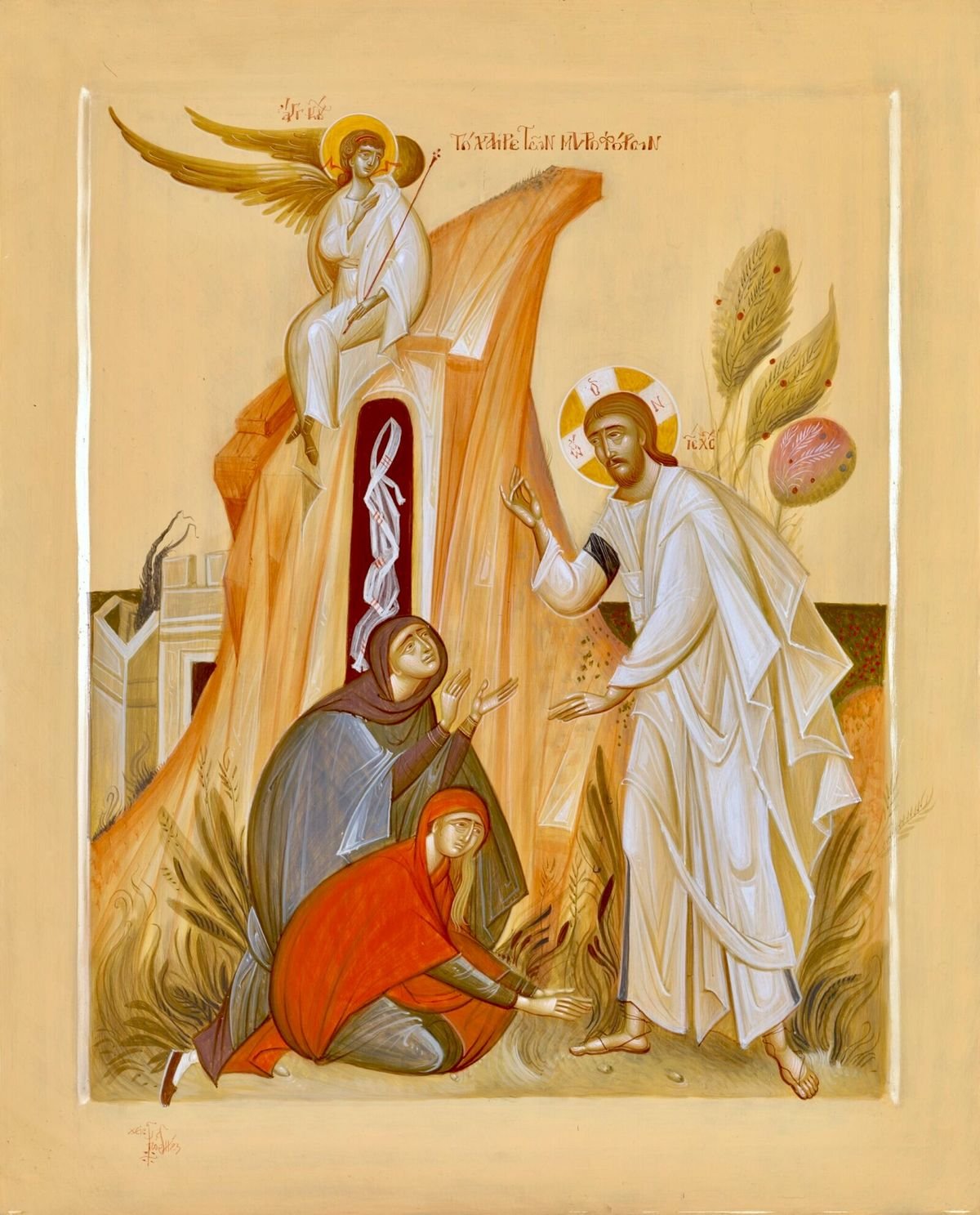
by Dr. George Kordis
Christ is risen!
On the third Sunday after Pascha, we are still talking about Pascha -- of course! Pascha is so important and so beautiful, that we truly spend a whole Paschal season unpacking it and savoring it and just marinating in it.
I love the third Sunday, because I adore the myrrhbearers.
First of all, I love the myrrhbearers because I know some. I have friends who are like those myrrhbearers -- women who take care of people, who notice without being asked that there is work to be done, and who quietly and even anonymously carry that load in loving service to their community and to Christ. Two of my favorite myrrhbearers actually chose myrrhbearers for their patron saints - Ioanna and Susanna - and they are so much like their myrrhbearing saints. It’s my hope to become like that someday, and to teach my children to be like that. To instinctively bring soup when someone’s sick, to notice when someone is depressed and to quietly offer a smile and a hand up -- this is love, and this is what our Lord calls us to do. That’s the love of the myrrhbearer.
Not only women can bear myrrh -- yes, they are the myrrhbearing women, but know that Nicodemus brought 100 pounds of myrrh and spices to our Lord’s burial, and that Joseph of Arimathea is honored with them because he provided the tomb and personally wrapped our Lord in linens. This kind of loving, physical caretaking is the very real, concrete love to which Christ calls us, and He calls equally to men and women.
But myrrhbearers hold a special place in my heart because of my own history with burial.
As you may know, I was raised a non-denominational Christian, and when our loved ones died we tried not to think about their bodies. The body is a shell, my parents assured me, just a husk. The soul has left, is safe in heaven, and the body is nothing to us. We can cremate it or bury it or cut it up for scientific investigation -- the body doesn’t matter, it’s the soul that matters.
In retrospect, I think we weren’t all that good at grieving; we almost encouraged each other not to grieve. After all, he was in a better place. Our loved one was in heaven, and we should be celebrating instead of mourning. Surely you’ve been invited to a Celebration of Life, where no one wants to mourn or cry -- funerals are no longer in vogue around here.
I was Orthodox for a few years before I’d have to bury anyone I loved. I knew that my worldview was changing, that I was understanding everything in a different way, but I didn’t see how much my understanding of incarnation and death had shifted until we buried our son.
At just six weeks old, our son died of Sudden Infant Death Syndrome. He was fine one moment and gone the next, so we were unprepared to say the least. We handed off his funeral arrangements to our priest. We didn’t even know what we were asking, but we told him to give Luka the most Orthodox funeral he could manage.
Our dear priest did all the paperwork and took care of all the arrangements. The parishioners signed up to read the Psalms over him in an all-night vigil. They visited him, kissed him, said prayers beside him, and read the beautiful words of St. David, those Psalms prayed by Christ Himself, over our boy.
At the services, I stood beside my son, whose open casket lay in the center of the church, and my feelings for him were exactly the same. This body was my Luka, as much as his soul was him. This body was an icon of Christ, an icon not made by human hands, but truly a magnificent and miraculous creation of God Himself. We tended to him lovingly, and we kissed him as befits an icon.
After we buried him, I found it very difficult to leave the cemetery -- you can imagine, if you haven’t been there yourself, that the mother of a young baby is not accustomed to leaving the baby anywhere, let alone unattended in a strange cemetery field. I still feel that way every time I leave the cemetery. I even feel it now at other people’s funerals. There is something that we leave behind. It’s ok to leave the body there in the cemetery, but to pretend that the body is simply a meaningless shell, is just not true.
We Orthodox believe that we can bless just about anything. We bless our houses and our cars -- what that really means, is that we ask the Holy Spirit to occupy material things, to have a presence there in a physical object. How much more can the Holy Spirit abide in us? When we are chrismated, the Holy Spirit is sealed inside of us! (I just chrismated my wonderful new goddaughter, Ana, on Holy Saturday, and with what joy did our whole church call out, “Sealed!” with every cross of chrism Father painted!) We receive Holy Communion, and we take Christ into our bodies. Even after we die, the Holy Spirit and our Lord remain in our bodies somehow. It's a mystery.
That’s why we venerate relics -- we know that something of their holiness, of God’s grace, remains in the bones of the Saints. And we see it. We see miracles all the time.
The myrrhbearers bring all of this beauty of Orthodox burial to me. Just as we lovingly tend to the bodies of those we love (our beloved icons of Christ) the myrrhbearers tended to the very body of God, to Jesus Christ Himself.
It's good for our kids to understand that the Orthodox treat bodies differently. We believe that every human body is an icon of Christ, and therefore we're going to treat that body differently in life and in death. We're going to cross ourselves, we are going to stand in church or kneel in prostration and we are going to sing and we’re going to fast. We are going to worship with our bodies because our bodies are part of us. All of our five senses, all of our limbs, our heart and our head - all of it. We are not split between body and soul, but instead we experience a unity of self.
When we encounter other human beings along our journeys, we receive them as icons of Christ. If they're hungry we feed them and if they're thirsty we give them a drink. We see Christ in every human body that comes our way and we try to love every one in accordance with that understanding.
So it should come as no surprise that when a person dies, we don't discard them, but instead we prepare them lovingly, as we would an icon. We know that this icon of Christ will rise again, that when the end of time comes and our Lord returns, every human body that ever has been will rise up in a general bodily resurrection -- we are fearfully and wondrously made, so we treat these bodies with amazement and respect.
Especially here in the West, where burial practices have changed so much over the years, it’s hard to explain the myrrhbearers to our kids. They always seem confused. Why are they putting myrrh and spices on him? Why were they wrapping him up? The kids immediately think of Egyptian mummies! Many of them have not seen a loved one die in their home, washed and dressed and cared for by the family, and they have not seen people gather to read Psalms over a body, to pray for the transition of that person to heaven. Perhaps a hundred years ago children would not wonder why a group might gather to go to the tomb to anoint their beloved Lord, but our kids are raised in a world where death is shoved to the side. People die in hospitals and nursing homes and are whisked off to funeral parlors. We don’t touch the bodies of our sleeping loved ones much around here.
This is another of those places where common Western societal norms and assumptions vary sharply from Orthodox teachings, so it’s a blessing to have an opportunity to discuss this with our children. If you’re interested, Dn. Mark Barna and his wife, Elizabeth, have written a book on Orthodox burial called, A Christian Ending: A Handbook for Burial in the Ancient Christian Tradition, and they even have a podcast here on Ancient Faith Radio. Our parish has been so inspired by their work that a new committee is forming, to create groups of Orthodox faithful, trained and ready to serve when an Orthodox person in our region requires a traditional burial.
Whenever we honor the human body, we recall the incarnation. Indeed, the myrrhbearers bear witness to the incarnation all over again: they remind us that God took on a real body, a body like our bodies, and that body suffered and was buried, rising on the third day.
When we celebrate the myrrhbearing women, we remember that they remained at our Lord’s side all the way through His crucifixion and death -- when others scattered, these women could not tear themselves away from Him. After Joseph of Arimathea and Nicodemus buried Him, they observed the Sabbath, and then the women came back again as soon as they could. They could not stay away.
Let’s think about that for a moment.
Peter, the boldest of the apostles, was asked three times, You are not also one of His disciples? Did I not see you in the garden with the Galileans? and each time, he denied it. Why? Because Jesus was not boldly and gloriously taking over Jerusalem. He was not enthroned as the rightful King of Israel. No, He was beaten and humiliated, arrested and about to be crucified like a common criminal. Peter was scared, and for good reason. Can you drink of this cup? It’s an intimidating cup.
The apostles scattered during the crucifixion, but John the Beloved and the myrrhbearing women stayed. I like to think that they could not tear themselves away from Jesus; their love overpowered fear.
If we think about Great & Holy Friday, our services are so somber and quiet, because our Lord is suffering. We have not yet moved to the time where He will triumph; we are still in the day of the crucifixion, a day of sorrow and pain, in which humanity receives its perfect, loving Creator and beats Him and hangs Him on a cross.
When we talk about the myrrhbearers approaching Christ’s tomb, we must remember that they’re still in Holy Friday, in a way. They don’t know that Christ is defeating death by death; they don’t know that what seemed to be His defeat is truly His victory. They are still in that sad, dark place, contemplating the horrors of how humanity has received its Lord.
But the myrrhbearing women never left. While Christ was up on the cross, suffering and abused, the myrrhbearing women stayed close. Before our crucified Lord became our risen Lord, before His suffering turned into triumph, they were right there. They loved the crucified Lord.
Joseph of Arimathea too -- he had much to lose, but he approached Pontius Pilate and obtained permission to bury Jesus in his own tomb. That’s a great expense and a big risk, but he took it, and we will remember forever how he wrapped our Lord lovingly and placed Him in the tomb.
They tended to our Lord while He was still this crucified, beaten body. They didn’t understand that He was about to rise up in glory -- but they came anyway. They loved Him when there wasn’t anything in it for them. They loved Him sacrificially, as He loves us.
In his recently published collection of homilies, titled, The Cross Stands While the World Turns, Fr. John Behr offers a Holy Friday homily in which he says,
“We yearn for a God who will lift us from our uncertainty, frailty, and fear, to see things from his lofty and implacable perspective, with all the things in his providential control, all problems solved as if by magic. [...] The God we want would remain in the heavens, speaking to us from the heights -- with clear edicts given for our improvement, so that we can satisfy ourselves that we have fulfilled our religious obligations.”
But instead of this magical Santa Claus God, we have our crucified Lord. On Holy Friday, He is beaten and torn and cries out, as Fr. John Behr continues,
“It is finished!
Now all we have is silence.
Every other time that Christ appeared to us in divine form -- at his birth, baptism and transfiguration -- we heard the voice of God from the heavens saying: ‘This is my Son, hear him.”
But this time, when Christ cried out in abandonment, we heard nothing, and we have nowhere else to look.
We are left gazing, unrelieved, at his broken body, and we have placed him in the earth.”
Fr. John reminds us that our crucified Lord is completely humbled person. He is not the Magician in the Sky who will solve all of our problems and put it all back together. No, He is the One who has been broken and placed in the earth. He is down here, suffering with us. He doesn’t just fix the problems, but instead He invites us to pick up our cross and to be transformed through suffering, through death.
Our dear Myrrhbearers, not even knowing as we do of the glory to come, put everything on the line to minister to our humbled, crucified Lord. Imagine that. They respond to His love with love, they respond to His sacrifice with sacrifice. And they don’t even know what joy is coming.
We should all cultivate that sacrificial love, and we should express it in real ways. That’s the thing about myrrhbearing. It’s not abstract. It’s not love sent from a distance, but it’s love lived out physically. Whether it’s anointing a body or washing the feet of a living, breathing person, it is concrete and physical love. We must serve one another, we must actually take care of one another. That’s what our Lord asks of us, and it’s how we become more like Him -- and more able to abide with Him forever.
It’s not necessarily about building wonderful, effective well-designed ministries. I mean, when the myrrhbearers were walking to the tomb, they realized that they hadn’t planned how to move the stone -- they continued on anyway, unable perhaps to imagine NOT going, and having faith, it seems, that our Lord could somehow make it happen. What role models they are!
Let’s tell our kids: when you are called to serve, don’t be deterred by obstacles. Show up, and see what happens. Say a prayer, ask for help, see what happens.
The myrrhbearers showed up for service. As it turned out, the stone was already rolled away, and the angel famously asked, “Why seek ye the living among the dead?” Willing to walk into death, they encountered life.
Christ is risen! Truly He is risen!
They hymns call out, "Myrrh is for the dead; but Christ has shown Himself a stranger to death." Amen.
When we are willing to serve sinners, we might slowly become saints. When we are willing to walk into the saddest, darkest places to care for an icon of Christ, we will somehow find joy and light. Our Lord rewards our efforts, and when we pick up our cross and follow Him, we may be venturing into the darkness of Hades, but we will find that His light is already there.
Christ is risen from the dead, trampling down death by death.
And upon those in the tombs He is bestowing life!